 SVGA
SVGA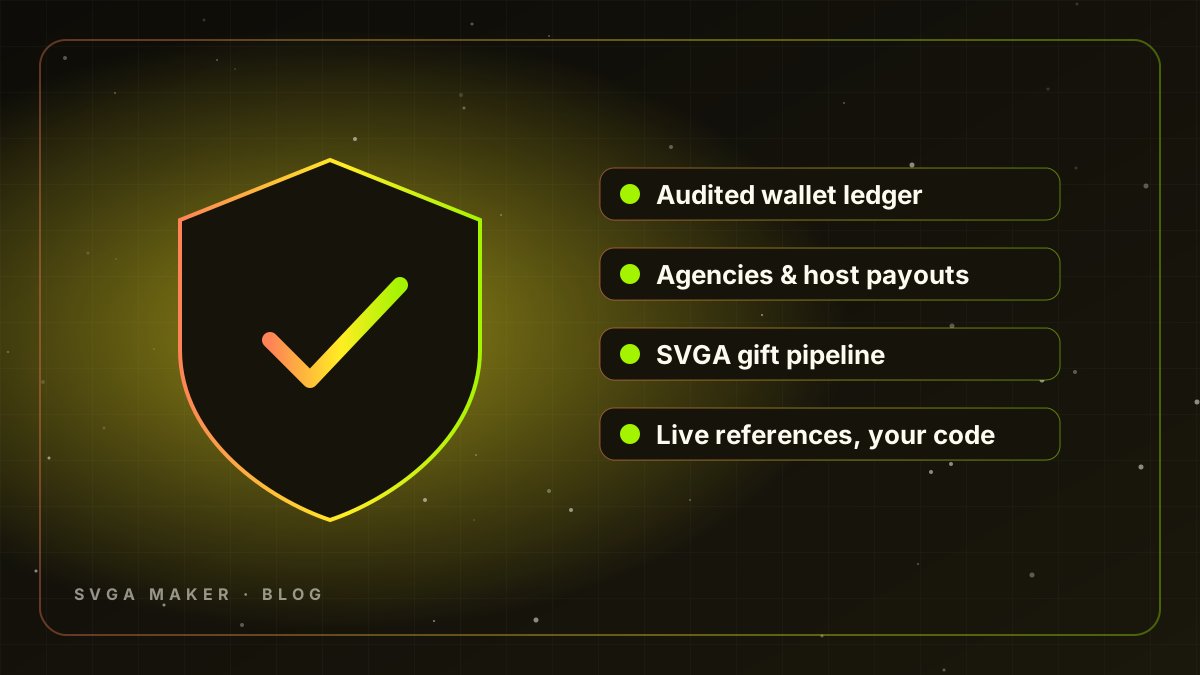
Searching for the "best voice room app development company" returns a wall of agencies promising a Yalla clone in 30 days. Most have never operated a live platform, never balanced a coin ledger, and never shipped a gift catalog. This guide gives you the questions that separate real partners from template resellers - and explains how AppLooma LLC approaches these projects.
Why voice-room apps are a specialist build
A voice-chat party app looks simple - rooms, mics, gifts - but it combines four hard disciplines: real-time audio at scale, a money system that regulators and app stores will audit, a virtual economy that must feel fair to hosts and spenders, and a content pipeline that produces new gifts, themes and effects every week. Generic app agencies are good at the first item at best. When evaluating vendors, weight the other three.
The ten questions to ask every vendor
- Which real-time provider do you use and why? Expect a clear answer about Agora, ZEGOCLOUD or Tencent TRTC, regional latency and pricing per minute - not "we build our own WebRTC".
- Show me your wallet ledger design. Ask for double-entry accounting, idempotent purchase handling, refund and chargeback flows, and payout KYC.
- How do you handle agencies and host contracts? The agency system is where scale comes from; a vendor who has not built one will underestimate it.
- What is your gift pipeline? Who designs the catalog, in what format (.svga), how fast, and at what cost per gift? This question alone eliminates half the field.
- Which markets have you launched in? Payment methods, languages (RTL for Arabic), festival calendars and moderation rules differ by region.
- How do you test on low-end Android? The audience is on 2-3 GB RAM phones; ask for their device matrix.
- What is in the admin console? Finance reports, catalog management, moderation queues, agency dashboards, campaign tools.
- Who owns the code and the store accounts? You must. Walk away from anyone who publishes under their own developer account.
- What happens after launch? Ask for an operations plan: monitoring, on-call, weekly catalog drops, monthly events.
- Can I talk to a client whose app is live today? References with live apps beat portfolios with mockups.
What a real proposal contains
A serious proposal reads like a product plan, not a feature list. It names the room model (voice, video, games), the real-time provider and its per-minute cost, the wallet model with fee structure, the gift catalog plan (tiers, count at launch, monthly refresh, file format and size limits), the moderation approach, the regional payment methods, a milestone timeline with acceptance criteria, and a post-launch operations retainer. If gifts and themes are a single line called "assets", the vendor has not run a live app.
Pricing models - and what is reasonable
- Fixed-price MVP - $60k-$150k in South Asia, Eastern Europe or LATAM for a voice-room app with wallet, agencies and admin; $250k+ with Western agencies.
- Dedicated team - $8k-$25k per month for a five-person squad; best once you are live and shipping continuously.
- Revenue share or white label - fast and cheap to start, but you rarely own the code or the users. Fine for a market test, dangerous as a long-term base.
Whatever the model, budget the gift catalog separately. An agency-produced catalog of 100 gifts costs $10k-$40k; AI-produced with SVGA Maker it costs roughly $100-$250 and takes a few days - which is why we build the pipeline into every project.
How AppLooma LLC does it
AppLooma LLC is a software company that builds products for the live-streaming industry - voice-room and party apps, live-commerce tools, and the creative AI products SVGA Maker (gifts, themes and video-to-SVGA conversion) and ShortAd AI (AI video ads). Because we operate our own live-industry products, our platform builds come with the parts template agencies skip: an audited wallet ledger, an agency and host system, a moderation console, regional payments, and a gift catalog produced with our own studio so your store is never empty. Projects are fixed-scope with milestone acceptance, source code is delivered to your repositories, and store accounts stay in your name.
Red flags that end the conversation
- A "ready-made Yalla clone" with a price and no discovery call.
- No answer on ledger reconciliation, refunds or payouts.
- Gifts delivered as GIF or MP4 files, or "designed later".
- No moderation plan, no device matrix, no reference with a live app.
- Ownership of code or store accounts kept by the vendor.
Next steps
Write a one-page brief: room model, target markets, launch catalog size, monetisation, budget range and timeline. Send it to three vendors and compare their proposals against the ten questions above. For the technical blueprint, read how to create a live streaming app and voice room party app; for the catalog, start with how to make SVGA gifts. To talk to AppLooma about your platform, write to [email protected].
A realistic delivery timeline
Discovery and UX (2-3 weeks): room model, gift economy design, wallet and payout rules, moderation policy, admin console scope. Build (12-18 weeks): rooms and real-time audio, wallet and store, gifting with SVGA playback, agencies, admin, payments. Beta (4-6 weeks): closed test with two or three agencies, device matrix on low-end Android, load tests on rooms with a thousand listeners, store review. Launch and operations: weekly catalog drops, monthly events, on-call support. Anyone promising a full platform in four weeks is selling a template with your logo on it.
Frequently asked questions
Is a white-label clone ever the right choice? For a market test with a small budget, yes - as long as you can export your users and re-platform later. Read the contract for data ownership and exit terms before signing.
Should the vendor also produce gifts and themes? Ideally the vendor gives you a pipeline, not a dependency. With SVGA Maker your own team can produce the catalog after handover, which is why we bundle it rather than billing per gift forever.
What ongoing costs should I expect? Real-time minutes (the largest line), cloud hosting and CDN, payment fees, app-store commissions on coin purchases, moderation staff, host bonuses and a monthly creative budget for the catalog.
How do I protect myself contractually? Milestone-based payments tied to acceptance criteria, source code in your repositories from week one, store accounts and domains in your name, and a defined post-launch support scope with response times.
Key takeaways
- Judge vendors on the wallet ledger, the agency system and the gift pipeline - not on the room UI demo.
- Insist on milestone acceptance, your own repositories and your own store accounts from day one.
- Budget the catalog separately and choose a partner who hands you a production pipeline instead of billing per gift forever.
- A credible platform takes five to seven months to a stable v1; four-week promises are templates.
Send your one-page brief to AppLooma and two other vendors, score the answers against the ten questions, and pick the team that talks about money flows and content operations before it talks about screens.