 SVGA
SVGA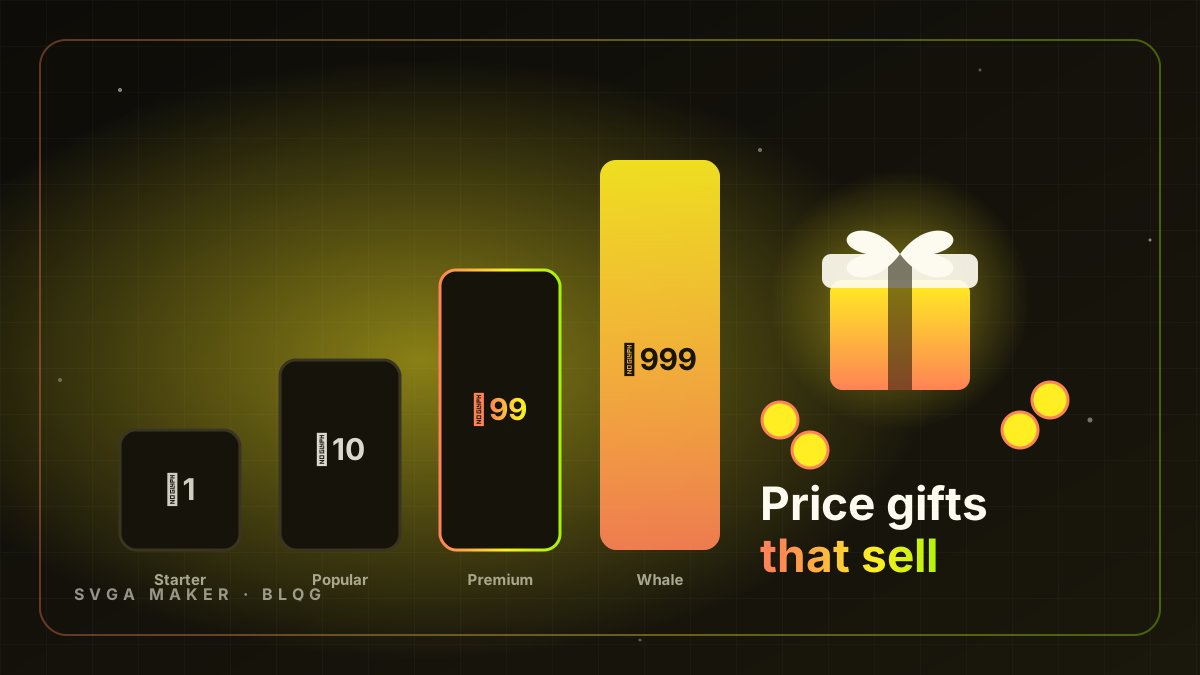
Every live-streaming and voice-room party app makes most of its money from one thing: virtual gifts. Yet most founders price their first gift catalog by copying a competitor's coin list and hoping for the best. The result is a flat catalog where nobody feels the difference between a rose and a rocket, and where the top 1% of spenders, the users who fund the entire business, have nothing worth showing off. This playbook explains how gift pricing really works in 2026, how to build tiers that sell, and how the animation quality of each gift changes what people are willing to pay.
1. Start with the coin, not the gift
Users never pay for gifts directly. They buy coins (or beans, diamonds, gems) and then spend coins. That extra step is deliberate: it separates the moment of paying real money from the moment of giving, which makes giving feel free. Three rules make a coin economy healthy:
- One coin should be worth less than one cent. Most successful apps sit between 0.5 and 1 cent per coin, so a 100-coin gift feels like a small tip and a 10,000-coin gift feels like an event.
- Coin packs should never divide evenly into gift prices. If the smallest pack is 700 coins and the popular gift costs 300, the user is always left with a remainder that pushes the next purchase.
- Show real-currency prices only on the pack screen. Inside the room, everything is coins. The mental conversion back to dollars is friction you do not want.
2. The four tiers every catalog needs
A catalog that converts has a clear ladder. Each tier has a job, a price band and a visual language that users learn within a few sessions.
| Tier | Price band | Job | Animation |
|---|---|---|---|
| Starter | 1 - 20 coins | Break the ice, keep the chat alive | Small, 1 - 2 seconds, no sound |
| Popular | 50 - 500 coins | Everyday appreciation, most volume | Full-screen burst, 3 - 4 seconds, light sound |
| Premium | 1,000 - 10,000 coins | Public status, room-wide notice | Cinematic 5 - 8 seconds with music, sender name shown |
| Whale | 20,000 - 500,000 coins | Dominance, loyalty, competition between fans | 10 seconds, room takeover, global banner across the app |
Notice the price jumps are roughly 10x between tiers. Linear catalogs (10, 20, 30, 40 coins) fail because there is no drama in choosing. Logarithmic catalogs create a visible statement with every step up.
3. Price the feeling, not the pixels
A gift is a public message: "I noticed you", "I am the biggest fan in this room", "I am richer than the person who just sent the car". The price must match the size of that message. That is why the animation matters so much: a 50,000-coin gift that plays as a tiny sticker feels like a scam, while a 200-coin gift with a cinematic explosion feels like a bargain and gets sent again and again.
In practice this means production quality should scale with price. Starter gifts can be simple loops. Premium and whale gifts need real motion design: a hero object, a build-up, a climax with sound, and a clean loop or exit. Studios that used to spend $300 to $800 per premium gift with agencies now generate them in minutes with SVGA Maker: describe the idea, get an HD .svga with sound, and drop it straight into the catalog.
4. Whale psychology: design the top of the ladder first
In most live apps, 1% to 3% of paying users generate 60% to 80% of gift revenue. These users are not buying animations; they are buying recognition. Three mechanics keep them spending:
- Room takeover. The whale gift pauses the room, shows the sender's name and avatar, and plays a 10-second animation everyone watches. Nothing else in the app should look like it.
- Global broadcast. Gifts above a threshold announce themselves in every room with a banner. The whale's name travels across the app.
- Exclusivity. One or two gifts should be unlockable only after a spending level. Scarcity at the top is worth more than another 50 mid-tier gifts.
Price these gifts high and keep them rare. A single well-designed whale gift often out-earns the entire starter tier.
5. Seasonal drops and limited editions
The catalog should change every month. Eid, Diwali, Lunar New Year, Ramadan, Valentine's Day, Independence Day, Halloween and Christmas each deserve a themed set with a starter, a popular and one premium gift. Limited editions do two things: they give regular spenders a reason to buy again, and they let you test price points without touching the permanent catalog. Retire them on a fixed date and users learn to act fast.
Because a themed set is four to six gifts, production speed decides whether you can afford to do this at all. With an AI gift studio, a full seasonal set takes an afternoon instead of a month, and you can localize the same gift for different markets by changing the prompt.
6. Combos, streaks and multipliers
Sending the same gift ten times in a row should feel better than sending it once. Show a combo counter, escalate the on-screen effect at x10, x50 and x99, and let the sender tap repeatedly. Combo mechanics quietly move a 100-coin gift into premium-tier revenue. Pair it with room leaderboards that reset weekly so the competition never ends.
7. The numbers to watch
- ARPPU (average revenue per paying user): rising ARPPU with flat conversion means your top tiers are working.
- Gift mix: if more than 80% of coins go through starter gifts, your ladder has a missing step.
- Whale share: the top 100 spenders' share of revenue. A healthy app sees it grow with each seasonal drop.
- Time-to-first-gift: if new users take more than one session to send anything, add a cheaper starter or a free daily gift.
- Refund and chargeback rate: the early warning that a gift's animation did not match its price.
8. Regional pricing without losing your economy
A 2,000-coin gift cannot cost the same in Dhaka, Jakarta and Riyadh. Keep coin prices global inside the app and localize at the pack level: the same 700-coin pack costs less in lower-income markets through regional store pricing. This preserves the social meaning of gifts (a rocket is a rocket everywhere) while matching local purchasing power. Never localize the gift's coin price itself; users travel between rooms and would notice immediately.
9. A launch catalog you can copy
For a new app, 24 gifts are enough: 8 starters (1 - 20 coins), 8 popular (50 - 500), 5 premium (1,000 - 10,000) and 3 whale gifts (20,000+). Add one seasonal set per month and one exclusive unlock per quarter. Review the gift mix every two weeks and retire anything that has not been sent in 30 days. Teams building on this model with an in-house gift pipeline, including studios run by AppLooma LLC, typically see the premium tier overtake starters within the first quarter.
Frequently asked questions
How much should the most expensive gift cost? Between $200 and $1,000 in real money for a mid-sized app; the largest platforms go far higher. Start at the low end and add tiers above it as whales appear.
Should gifts have a revenue split with hosts? Yes. A 40% to 60% share to the host is standard and it is what keeps talent on your platform. The animation quality of gifts is part of what the host is selling, so invest in it.
Do I need SVGA for gifts? SVGA is the standard for gift animations in live apps because it is small, supports transparency and embeds sound. Converting existing MP4 gifts to .svga takes minutes with a converter, and new gifts can be generated directly as .svga.
Key takeaways
- Price coins under a cent and make packs that never divide evenly into gifts.
- Build a four-tier ladder with roughly 10x jumps: starter, popular, premium, whale.
- Animation quality must scale with price; a great premium gift is your best salesperson.
- Design for whales first: room takeover, global banners, exclusivity.
- Ship a themed set every month; AI gift generation makes this affordable.